Transport simulation testing
The right test shows what your packaging must survive.
Send us your test specification
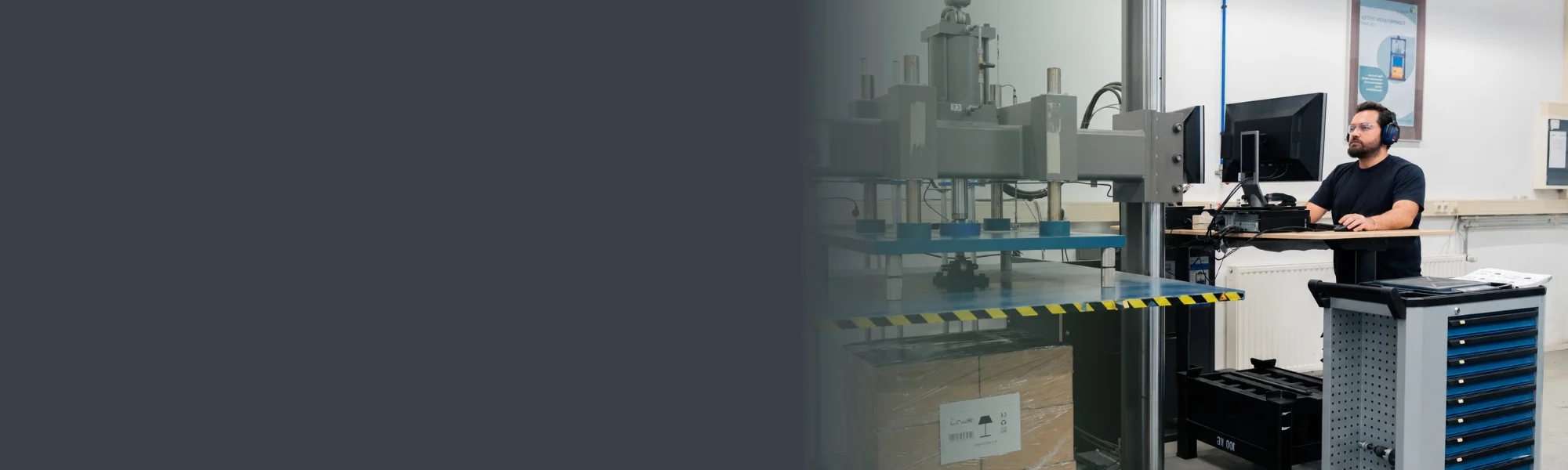
What is transport simulation testing?
Transport simulation testing is a lab test that reproduces the vibration, drops, shocks, stacking pressure, and climate a packed product meets between your warehouse and your customer. The test follows a fixed sequence, so the result is repeatable and comparable between designs.
The goal: find out whether the packaging protects the product before you ship hundreds or thousands of units.
Term explained
Death on Arrival (DOA) is a product that arrives broken or does not work on arrival. Transport simulation shows the DOA risk while you can still change the design.
What does transport simulation replicate?
Four loads. Each one causes its own typical damage.
Road, rail and air transport
Simulated with: fixed displacement or random vibration, with or without top load
You find: loose connectors, abrasion, cracked solder joints, shifting contents
Manual and mechanical handling
Simulated with: drops on faces, edges and corners, impacts
You find: broken housings, dented corners, cracked displays, split seams
Stacking in trucks and warehouses
Simulated with: compression
You find: crushed cartons, collapsed pallets, deformed products
Temperature and humidity
Simulated with: atmospheric conditioning before or during the test
You find: weakened board, failing tapes and adhesives, condensation damage

When do you need transport simulation testing?
When product, packaging or route changes, or when someone asks you for proof.
✓ Product launch. A test uses a few samples. A problem after launch hits every unit.
✓ Packaging change. New board, insert, closure or supplier? Your old result no longer applies.
✓ Customer requirement. Amazon has its own ISTA 6 protocols. Retailers ask for test reports.
✓ Recurring damage. We reproduce the failure, so you fix the cause and prove the fix.
✓ Packaging reduction. You need proof a lighter design still protects.
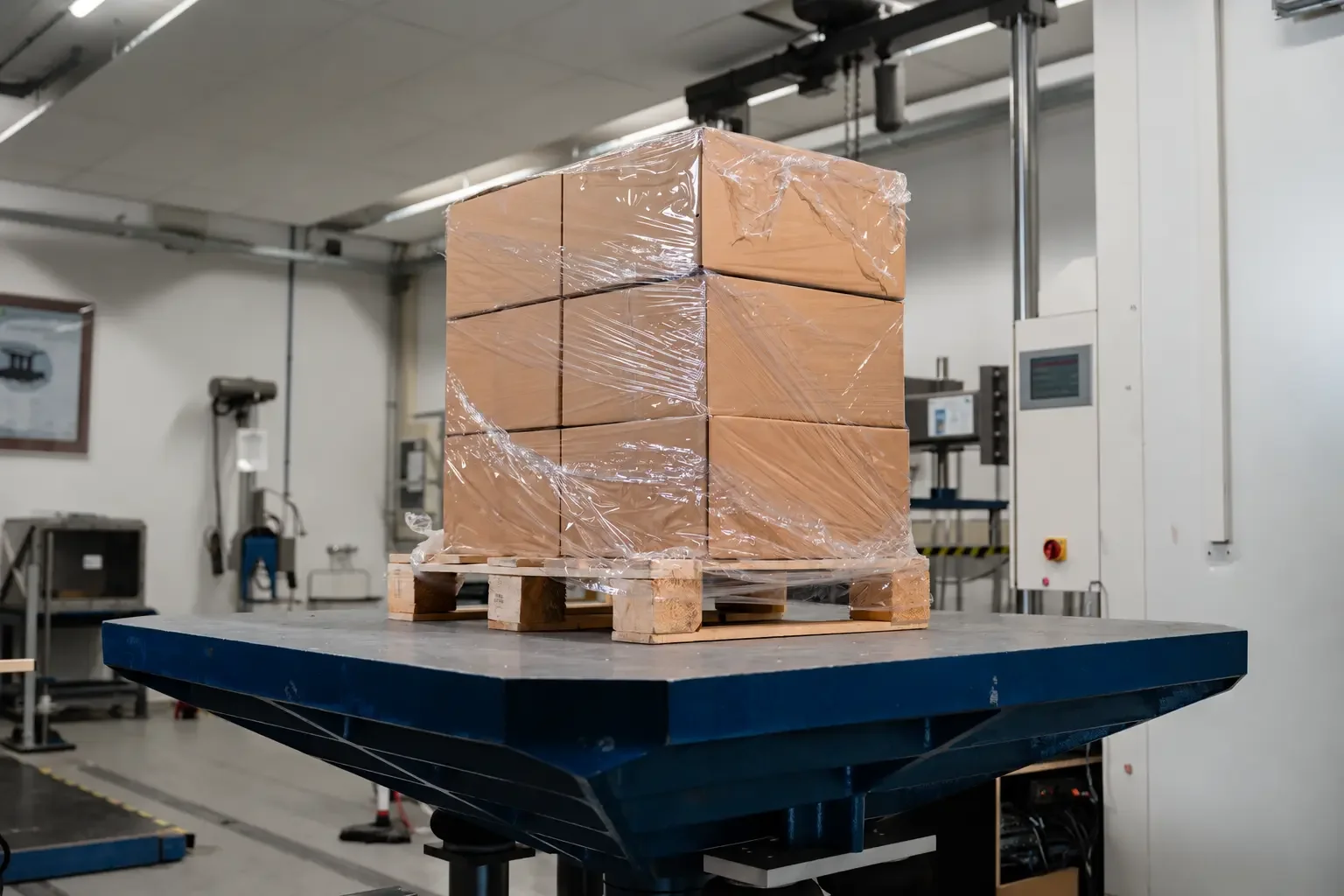
Which ISTA test do you need?
The right ISTA test depends on how your product ships: as a single parcel, in a mixed truck, as a unitised load on a pallet, or under a customer's own protocol. Start from your shipping method, not from the procedure number.
By shipping method
| How your product ships | Typical procedure |
|---|---|
| Single parcel through a parcel carrier, up to 70 kg (150 lb) | ISTA 3A |
| Through Amazon, in its own retail packaging (SIOC) | ISTA 6-Amazon.com-SIOC |
| Through Amazon, in an extra shipping box (over box), up to 32 kg (70 lb) | ISTA 6-Amazon.com-Over Boxing |
| In a mixed truck with goods from other shippers (LTL) | ISTA 3B |
| As a utilised load of identical packs on a pallet, a full truck | ISTA 3E |
| Fast-moving consumer goods to European retail on roll cages or mixed pallets | ISTA 3K |
| A quick screening of a pack up to 68 kg (150 lb) | ISTA 1A or 2A |
|
A quick screening of a pack over 68 kg (150 lb) |
ISTA 1B, 1H or 2B |
LTL (Less-Than-Truckload) is a shipment that shares a truck with goods from other shippers. LTL freight is loaded, unloaded, and moved by forklift more often than a full truckload.
A unitised load is a group of identical packs combined into one unit, usually stacked on a pallet and secured with stretch film or straps.
SIOC (Ships In Own Container) means the product ships to the end customer in its own packaging. An overbox is an extra shipping box around one or more retail packs, usually with void fill.
By ISTA series
| Series | What it tells you | Use it when |
|---|---|---|
|
Series 1: non-simulation integrity |
Whether the product and pack withstand a fixed set of basic loads . |
You want a quick screening test or a consistent. |
|
Series 2: partial simulation |
Basic loads plus at least one realistic element, such as atmospheric conditioning or random vibration. |
You need more than a screening, but not a full route simulation. |
|
Series 3: general simulation |
How the pack performs in a typical distribution system, such as parcel delivery, LTL or unitised loads. |
You ship through a known type of network and want a realistic result. |
|
Series 4: enhanced simulation |
A test plan built on known distribution data for your route. |
You know your supply chain in detail and want the test to match it. |
|
Series 6: member performance |
Protocols developed with specific companies, such as Amazon and FedEx. |
Your customer or carrier requires their own protocol. |
|
Series 7: development |
Relative performance of two or more designs, including thermal transport packaging. |
You are comparing design options during development. |
Frequently asked questions by engineers
At two moments. Test prototypes early to compare options before you order tooling or materials. Test the final design to verify it before launch or before you send results to your customer. Testing only at the end leaves little room to change the design.
No. A passed test shows the packed product survives the hazards of the simulated route at the severity the procedure defines. Real shipments vary. A passed test lowers the risk of damage on that route, and it gives you a documented baseline if damage occurs later.
Start with a standard procedure when your customer, retailer or logistics partner asks for one, or when you want results others recognise. Consider a custom profile when your route does not match any standard procedure, for example a mix of pallet and parcel transport. Your customer's own protocol is also an option. We confirm the choice in the test plan before testing starts.
Both, as one system. You send the product packed exactly as it ships. After the test we inspect the packaging and the product, and check the product against your pass/fail criteria, such as no visible damage or full function.
The most common mistake
Using a series 1 test as proof for e-commerce. Series 1 shows basic strength. It does not simulate repeated parcel sorting.
Shipping by parcel?
Use ISTA 3A or a Series 6 protocol.
How can transport testing reduce packaging?
By comparing your current pack with a lighter variant under the same procedure. You only switch if the lighter one passes.
- Baseline: test your current packaging.
- Variant: test a lighter or smaller design, same procedure.
- Decision: passes? Switch. Fails? You see where to reinforce.
What you save:
- Material: no extra layer or heavier board "just in case"
- Shipping cost: smaller boxes have a lower volumetric weight
- Waste: a damaged product is shipped twice, packed twice and often scrapped
Regulation: the EU PPWR sets requirements for minimising packaging weight and volume. Test results document your design changes.
Not included: a transport test does not calculate a carbon footprint or LCA. Use the result as input for those.
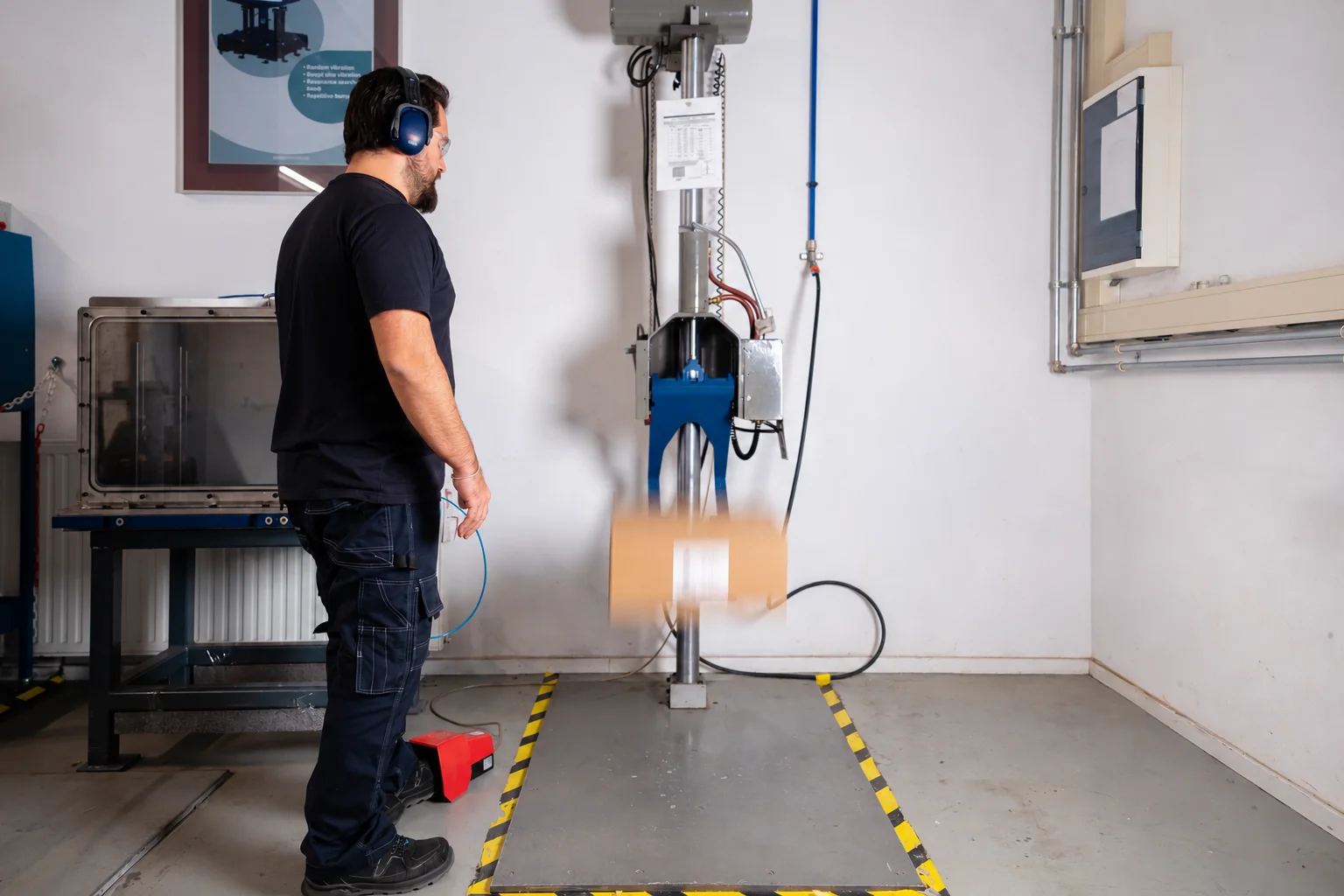
Typical test scenarios per industry

E-commerce and retail

Consumer electronics

Medical devices

Industrial and high-tech
How does a transport test work?
In four steps. You talk to the same test engineer throughout.
01. Request
You send product, packaging and any customer spec. We check the procedure fits your route.
02. Test plan
We agree on the procedure, number of samples and pass/fail criteria before testing.
03. Execution
Samples are conditioned and tested in the prescribed sequence. Every step is recorded.
04. Report
Set-up, observations, photos and the outcome per criterion.
What do you need to send us?
Product, packaging, shipping method, and acceptance criteria.
- Product description, weight, and dimensions
- Packaging: materials, inserts, closure
- Shipping method: parcel, pallet, crate, LTL, full truck
- Required procedure or customer spec, if any
- Acceptance criteria: visual or functional
- Number of samples available
- Deadline
Missing something? Don't worry, send us what you have.
What do you receive after testing?
A test report you can share as evidence with your customer, retailer or logistics partner.
- Procedure, set-up, sequence and observations
- Photos of pack and product, before and after
- Pass or fail per criterion, with location and type of damage
The ISTA Transit Tested mark is a label a shipper may print on packaging after a passed ISTA test. ISTA grants it, not the lab. The shipper must be an ISTA member, all samples must pass and ISTA must approve the report.
Find out what your packaging really needs
New packaging, a launch or damage that keeps coming back? Tell us what you ship and how it travels. A test engineer replies with a proposed procedure and the next step. Missing something? Send what you have.
✓ ISTA Certified Testing Laboratory · ID 9778
✓ Advice on the procedure before you commit
✓ Direct contact with your test engineer
Your contact: Mustafa Onur Akcura, Test Lab Manager mustafa@testlabsolutions.com
Prefer to talk first? Call us on +31 6 1345 6589